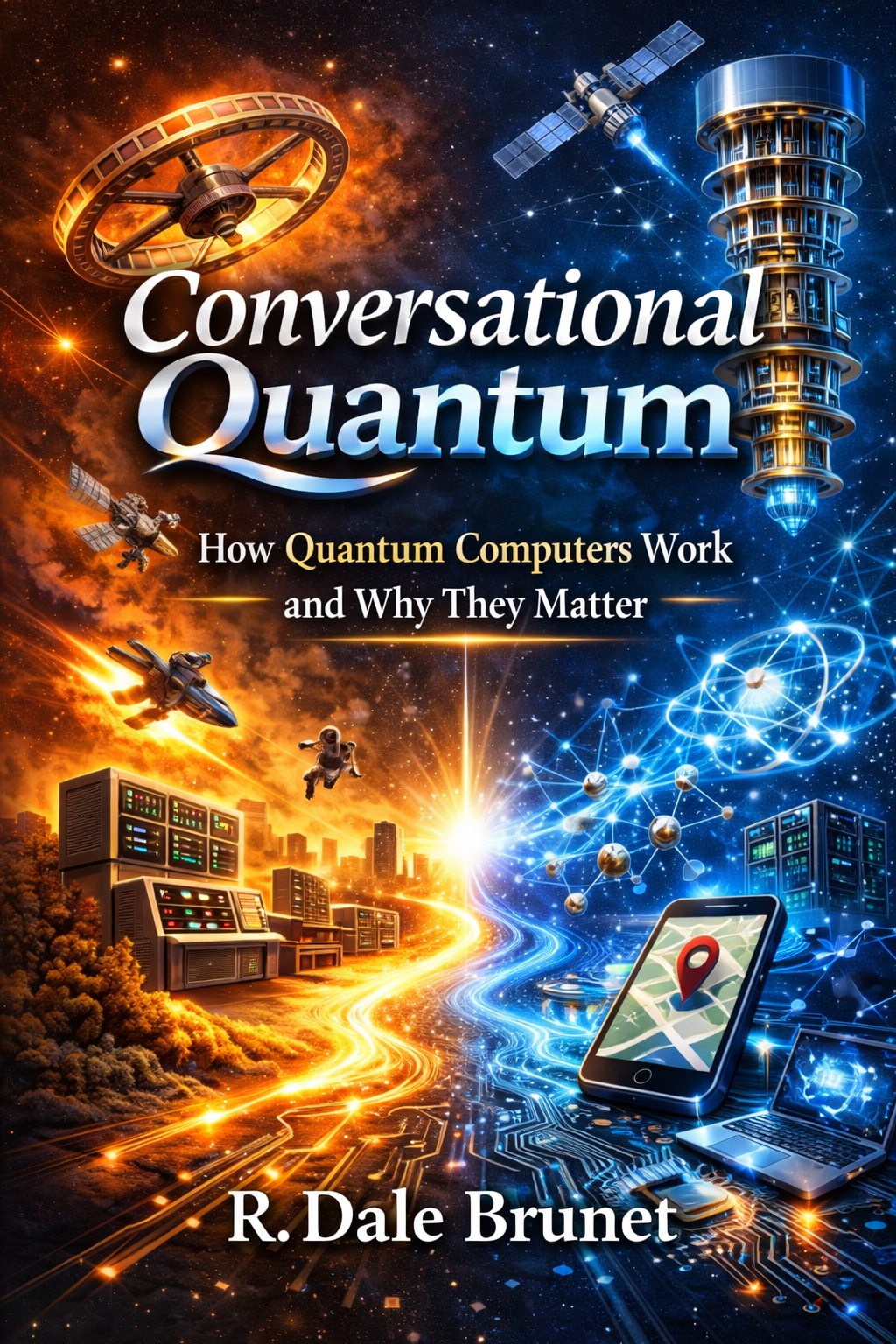
About the book
Quantum computing is one of those subjects most people have heard about and few feel they understand. The headlines promise revolutions and warn that quantum machines will break the internet, while popular explanations often lean on mystical language that leaves readers more confused than before. Conversational Quantum takes a different approach. It explains the ideas the way an experienced engineer might over a long conversation, starting from what readers already know.
R. Dale Brunet begins with his own path through classical computing, from circuits and certainty to the clockwork universe of Newtonian physics, and then describes the point where that picture stopped working. From there he walks through the core concepts one at a time: why tiny does not mean simple, superposition explained without the mysticism, entanglement explained cleanly, and what measurement really does to the possibilities a quantum system holds.
The middle of the book connects those ideas to computing. It compares bits with qubits, explains how quantum gates work as rotations of a state, and shows why interference rather than "trying every answer at once" is where quantum computation actually happens. It then describes what it takes to build a quantum computer and why keeping one stable is so difficult.
The final chapters look at practical consequences. They explain the algorithms that matter, what quantum computing means for encryption and data security, and where it may help in medicine, materials science and energy. A chapter on quantum computing and artificial intelligence separates realistic expectations from speculation, and another answers a question many readers quietly have: whether ordinary people will ever own one. The book closes with a look at how technological revolutions tend to unfold and an argument for meeting this one with curiosity rather than alarm.
Brunet spent more than three decades in information technology and writes for readers without a background in physics or advanced mathematics. The aim is not to turn readers into physicists but to give them a working understanding solid enough to read the news, ask good questions and recognize hype when they see it.
Conversational Quantum is for professionals, students, business leaders and curious readers who want to understand quantum computing in plain English.