

As technology becomes more capable,
what happens to the human role?
What about me?
Human Continuity Architecture (HCA) is an emerging field of study examining how human agency, judgment, participation, accountability, knowledge, labor, memory, and continuity change as capabilities once performed by people are increasingly shared with or transferred to technological systems.
Not anti-AI. Not anti-progress.
A more deliberate future.
The Technological Shift
Technology changes what machines can do.
HCA asks us to be equally deliberate about what happens to the humans.
WHAT ABOUT ME?
"What about me?" is not a demand that the individual always prevail. It is a question of human agency: Where is the individual in the systems, decisions, technologies, and institutions increasingly shaping human life?
HCA asks whether people remain meaningful participants in decisions that affect them—even when those systems operate at enormous scale.

Four Areas of Inquiry
People
Human agency, participation, dignity, identity, authorship, and opportunity.
Technology
Increasing capabilities, emerging systems, automation, artificial intelligence, and new possibilities.
Choices
Tradeoffs, consent, accountability, influence, judgment, and who gets to decide.
Tomorrow
How human continuity can remain intentional as technological capability expands.

Three Foundational Questions
I AM.
Existence. Identity. Presence.
I WAS.
Memory. Provenance. Continuity.
WHAT ABOUT ME?
Agency. Participation. Choice.
Together, these questions begin to frame an inquiry into what should remain meaningfully human as technology assumes capabilities that once belonged primarily to people.
 8B
Protagonists
Eight billion protagonists.
Humanity is collective. Human experience is individual.
Every person experiences the world from the center of a life that matters to them.
HCA explores what happens when systems designed for billions of people inevitably abstract those individuals into users, customers, citizens, workers, patients, datasets, demographics, and averages.
The challenge is not eliminating scale.
The challenge is ensuring that the human being does not disappear inside it.
This is what we think.
Prove us wrong.
Human Continuity Architecture is not being presented as finished doctrine. It is an evolving investigation. Ideas will be proposed, researched, challenged, tested, revised, and sometimes discarded.
The objective is not to defend every idea. The objective is to discover which ideas survive serious examination.
I could be wrong.

From the Researcher
Why am I asking these questions?
R. Dale Brunet has spent more than four decades working with technology—as a developer, entrepreneur, business owner, author, and increasingly as a student of artificial intelligence and its implications for ordinary human life.
Human Continuity Architecture grew not from an assertion that he already had the answers, but from years of asking questions about technology, people, institutions, memory, agency, and the future.

I am not claiming to be.
I am becoming.
Join the inquiry.
You do not have to agree with the premises. In fact, thoughtful disagreement is part of the work.
Ideas
Propositions, frameworks, and emerging concepts worth exploring and challenging.
Research
Investigations, evidence, and the evolving body of HCA inquiry.
Conversation
A space for questions, disagreement, and the exchange of perspectives.

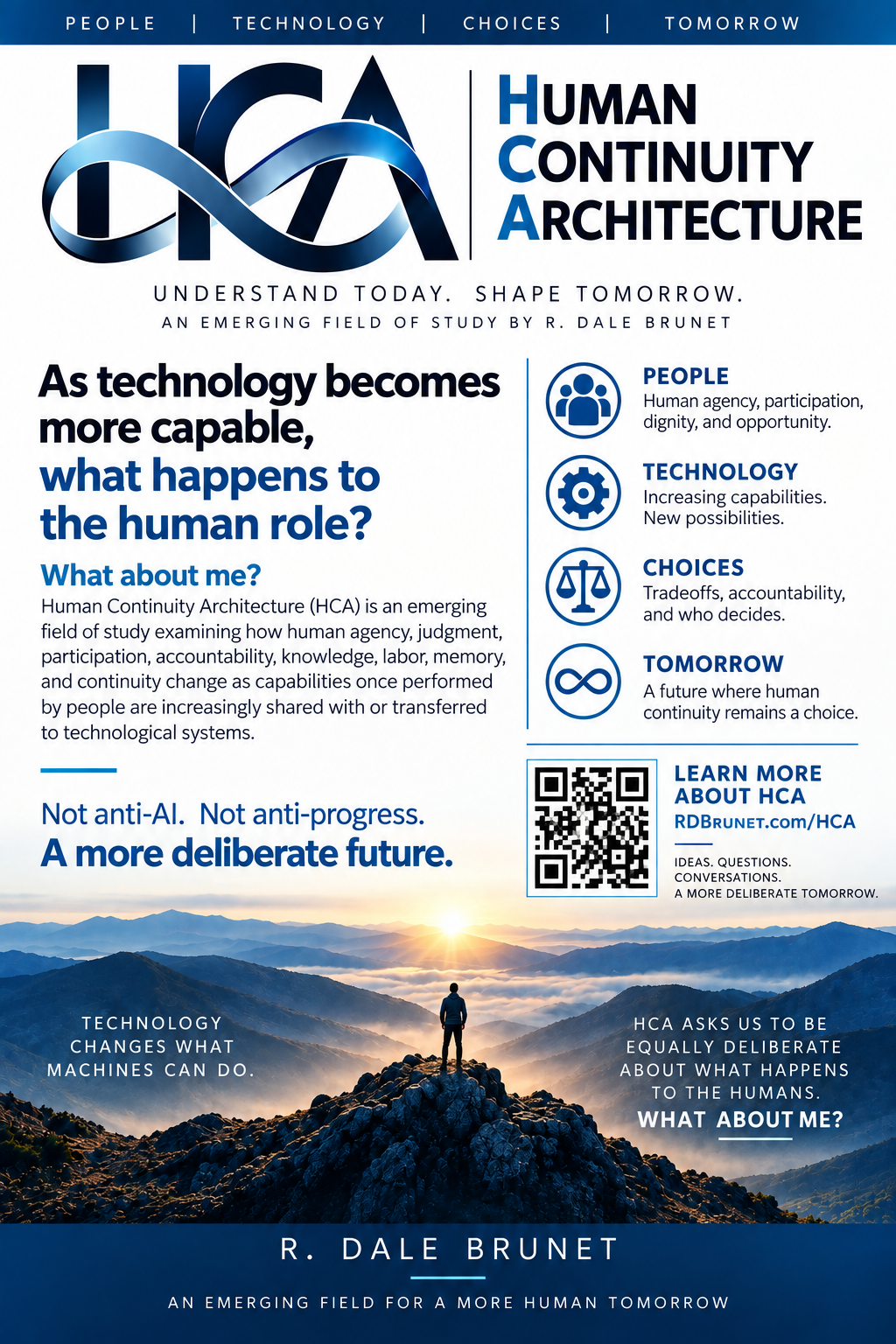
HCA One-Pager
Download the overview (PNG)
Continue the conversation
Interested in discussing HCA, inviting R. Dale Brunet to speak, or bringing these questions into your organization?
Work With R. Dale Brunet