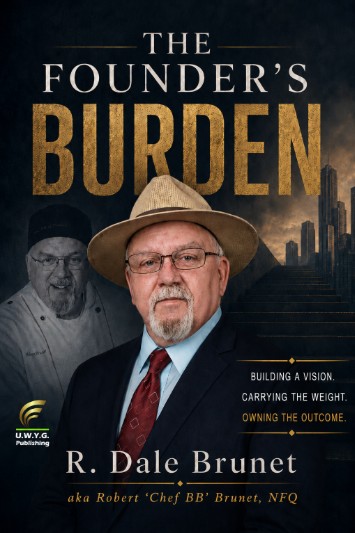
About the book
People love founders once the proof arrives. They admire the company after it has customers, quote the founder after the story has been polished, and celebrate the vision after the market has validated it. Before that, the founder is often just a fool with a notebook, someone trying to explain something that does not yet exist to people who want evidence before they will believe. The Founder's Burden is about that earlier, lonelier stretch, and about everything that follows.
R. Dale Brunet writes from long experience of building, losing and starting over. The opening chapters examine what it means to believe before there is proof: why the idea itself is not the hard part, how to explain something before the language for it exists, and the confusion when encouragement from friends feels like commitment and then disappears.
The book takes an unflinching look at how success and failure are judged. Success has many fathers and failure is an orphan; luck usually finds the people who are working; ownership is not the same as wealth; and the greedy owner of popular imagination rarely resembles the person signing the payroll. Brunet explains why businesses are viable until suddenly they are not, why the unbroken success story is a myth, and why hindsight is easy when it has no payroll to meet.
The center of the book addresses what happens after a business closes. Chapters on the internal trial every founder holds, advice from people who carry no consequences, the courage to be wrong in public, the shame ledger and the value of scar tissue lead to a simple conclusion: the business closed, the founder did not. Brunet's own operating principle, NFQ, never quit, runs through these pages without turning into a slogan.
The final chapters consider the pull of large corporations and profit without conscience, and close with a philosophy of leadership: belief paired with accountability, credit shared loudly, responsibility carried clearly, and stewardship valued over performance.
The Founder's Burden is for entrepreneurs in the middle of the climb, founders who have closed a business and are wondering what comes next, and the families, employees and friends who want to understand what the people building things are carrying.